A Day in the Life of a Medical Assistant
It’s 7:45 a.m., and before most people have finished their first cup of coffee, a medical assistant is already pulling up patient charts, restocking exam rooms, and prepping for the first appointment of the day. By noon, they’ve taken vitals, assisted with a minor procedure, fielded insurance questions, and helped a nervous patient understand their discharge instructions. That is what a day in the life of a medical assistant actually looks like, and it moves fast.
If you’re considering a career in healthcare but want to start working sooner rather than later, understanding this role from the inside out is a smart first step.
What Does a Typical Day Look Like?
The day in the life of a medical assistant rarely follows a script. Once patients arrive, the MA is often the first clinical face they see. Greeting the patient, collecting updated health information, measuring vital signs, and documenting everything in the electronic health record are all part of the opening routine. Then it’s on to the next room, and the next patient. In busier clinics and urgent care centers, that rhythm continues without much of a pause.
Midday often means balancing patient flow with behind-the-scenes tasks like answering phones, coordinating lab results, scheduling follow-ups, and helping the care team stay on track. The afternoon typically brings more of the same, occasionally with hands-on procedures like EKGs, wound care, or injections. Before the day ends, MAs help close out the office by completing records, restocking supplies, and sometimes meeting briefly as a team to discuss the next day.
Clinical vs. Administrative Responsibilities
This is where the role gets interesting. Medical assistants work across two distinct lanes, and most do both on any given day.
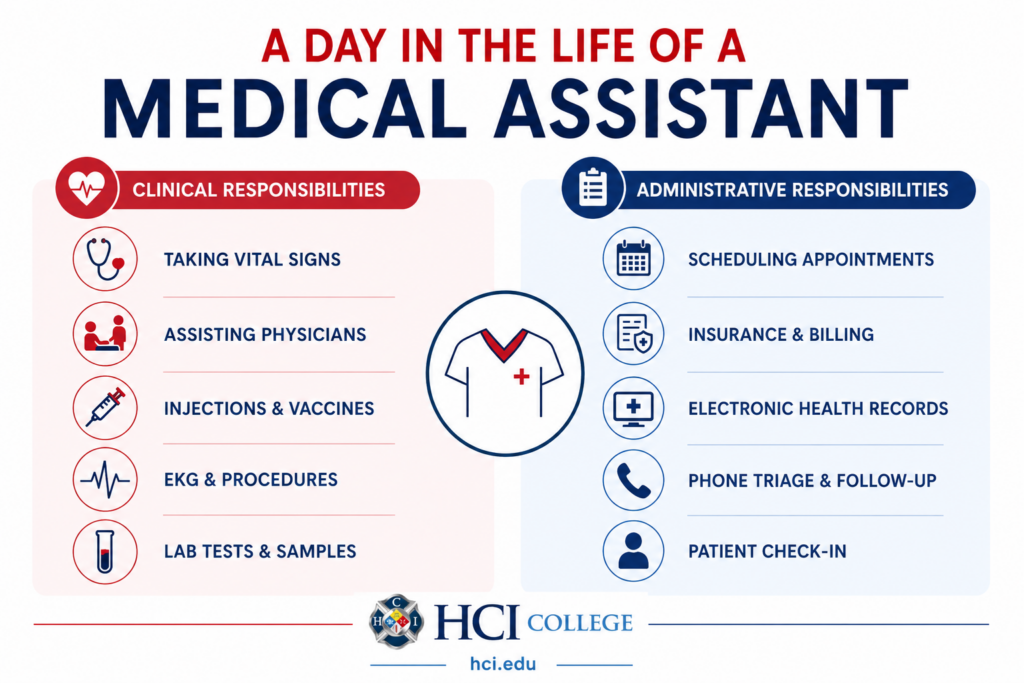
[Alt Text: Clinical and administrative responsibilities of a medical assistant.]
- Clinical Duties
• Taking and recording vital signs
• Preparing patients for exams
• Assisting physicians during procedures
• Collecting specimens and performing basic lab tests
• Administering vaccines and injections (where state law permits)
- Administrative Duties
• Patient scheduling and check-in
• Medical coding and insurance forms
• Phone triage and follow-up coordination
• Managing and updating electronic health records
The clinical workload shifts depending on the specialty. For example, an MA in a midwifery practice spends time preparing for Pap smears and fetal monitoring, while one at an urgent care center might be drawing blood and setting up for suturing. In smaller practices, a single MA might manage both the front desk and the exam rooms during the same shift.
This dual role is precisely why medical assistant programs that train students in both skill sets matter so much. An MA who only knows one side of the job is less valuable and less versatile than one who can move fluidly between patient care and office management.
Work Environments for Medical Assistants
The day in the life of a medical assistant looks different depending on where they work, and the options are wider than most people expect.
About 811,000 medical assistants were employed across the U.S. in 2024, with the largest share working in physician offices. But physician offices are just the starting point. MAs also work in:
• Outpatient care centers and specialty clinics
• Urgent care centers and community health facilities
• Hospitals and long-term care settings
• Telehealth platforms, supporting virtual visit coordination and remote patient monitoring
Specialty clinics tend to be more predictable in terms of patient volume and procedure types. Urgent care centers and hospitals are faster-paced and more variable. Each setting comes with its own pace and demands, which is one of the reasons MAs value the flexibility the role offers.
Skills You Use Daily on the Job
The role of a medical assistant calls on a wider range of skills than most entry-level healthcare roles. It’s not just about knowing how to take a blood pressure reading; it’s about doing it quickly, documenting it accurately, and then pivoting immediately to the next task.
The skills that come up daily include:
• Clinical competency: Accurate vital signs, proper specimen collection, safe injection technique, and familiarity with basic procedures are non-negotiable.
• Electronic health records: Nearly every clinic runs on an EHR system. MAs who are comfortable navigating these systems work more efficiently and make fewer errors.
• Communication: Excelling in patient relations means explaining a doctor’s instructions clearly to an anxious patient or relaying relevant history to a provider before they enter the room, which requires both clarity and compassion.
• Multitasking: In a busy clinic, MAs are constantly shifting between tasks. Time management is not optional.
• Adaptability: No two days look the same. The ability to stay organized and calm under pressure is what separates good MAs from great ones.
The U.S. Bureau of Labor Statistics projects employment of medical assistants to grow 12 percent from 2024 to 2034, much faster than the average for all occupations, with approximately 112,300 job openings expected each year over the decade. That kind of growth reflects real demand for people who have all of these skills, not just some of them.
Start Your Medical Assistant Career at HCI College
HCI College offers a Medical Assistant program at campuses in Fort Lauderdale and West Palm Beach, putting students at the center of one of Florida’s most active healthcare markets. The curriculum covers both clinical and administrative training, so graduates are ready to contribute from day one. To learn about healthcare careers in South Florida and how to get started, contact HCI College today.
If you found this article helpful, please share it on social media.