Why Is Hands-On Training Important in Healthcare Education?
Picture your first blood draw on a real patient. The arm is warm, the vein rolls slightly, and the person in the chair is watching your face for any sign of uncertainty. If this is the first time you’ve ever held a needle, both of you will feel it. If it is your fortieth attempt, after weeks of practice on training arms under an instructor’s eye, your hands stay steady and your patient relaxes.
That gap between knowing and doing is exactly why hands-on training in healthcare exists. Textbooks explain why a procedure works in a real-world healthcare environment. Repetition teaches your hands how to perform it when someone’s comfort, and sometimes their safety, depends on you.
What Is Hands-On Training in Healthcare?
Hands-on training covers every part of a program, allowing students to develop practical skills instead of reading about them. Most programs focus on three settings:
- Skills labs: Students practice core tasks such as checking vital signs, giving injections, and dressing wounds on task trainers and mannequins.
- Simulation: Lifelike mannequins or trained actors present realistic scenarios, from a patient whose blood pressure suddenly drops to an anxious family member full of questions.
- Clinical rotations: Students work beside licensed professionals in hospitals, clinics, and long-term care facilities, caring for real patients under supervision.
Each setting raises the stakes a little. A well-designed program moves students through them in order, so confidence grows along with competence.
Why Practical Experience Matters
Healthcare leaves little room for learning on the fly. A medication calculation, a sterile technique, or a missed change in a patient’s breathing can shape an outcome within minutes. Practical experience gives students a place to make their early mistakes where nobody gets hurt.
Research supports the importance of developing practical skills in training healthcare professionals. A 2024 review of simulation-based training published in the journal Medicine found that it improves skill acquisition, reduces errors, and lets learners repeat procedures as often as needed without putting patients at risk. The authors also credit immediate feedback and structured debriefing with making those lessons stick.
Practice builds softer abilities as well, like reading a patient’s body language, explaining a procedure in plain words, and staying calm when a monitor alarm sounds. Students who get consistent hands-on training in healthcare programs walk into their first job already familiar with the sounds, pace, and pressure of a real-world care setting.
How Clinical Training Prepares Students
Clinical rotations are where the pieces come together. Students follow a real patient load, document care in real charting systems, and see how nurses, physicians, and practical nurses divide the work of a single shift. They also meet the parts of the job that textbooks skim over, such as handoff reports and conversations with frightened families.
That exposure matters because the first year in any clinical role is demanding. According to the 2026 NSI National Health Care Retention and RN Staffing Report, 22.7% of newly hired registered nurses left their hospital within 12 months. Employers recognize the pressure, so roughly three in four hospitals now have a formal retention strategy, and most of those include a plan built specifically around new hires.
Graduates who have already logged substantial clinical rotations start that stretch on firmer footing. They know how a unit flows, whom to ask for help, and how to prioritize when three call lights go on at once. Rotations also sharpen clinical judgment, the ability to connect what you observe with what the patient needs next.
What to Look for in a Training Program
Programs differ widely in how much practice they deliver, so ask pointed questions before you enroll.
- Secured clinical placements: Clinical seats are scarce nationwide. In its May 2026 data release, the American Association of Colleges of Nursing reported that 93,176 qualified applications were turned away from baccalaureate and graduate nursing programs in 2025, with insufficient clinical placement sites among the primary barriers. Ask every school how it arranges rotations and whether each student is guaranteed a spot for clinical experience in diverse healthcare settings.
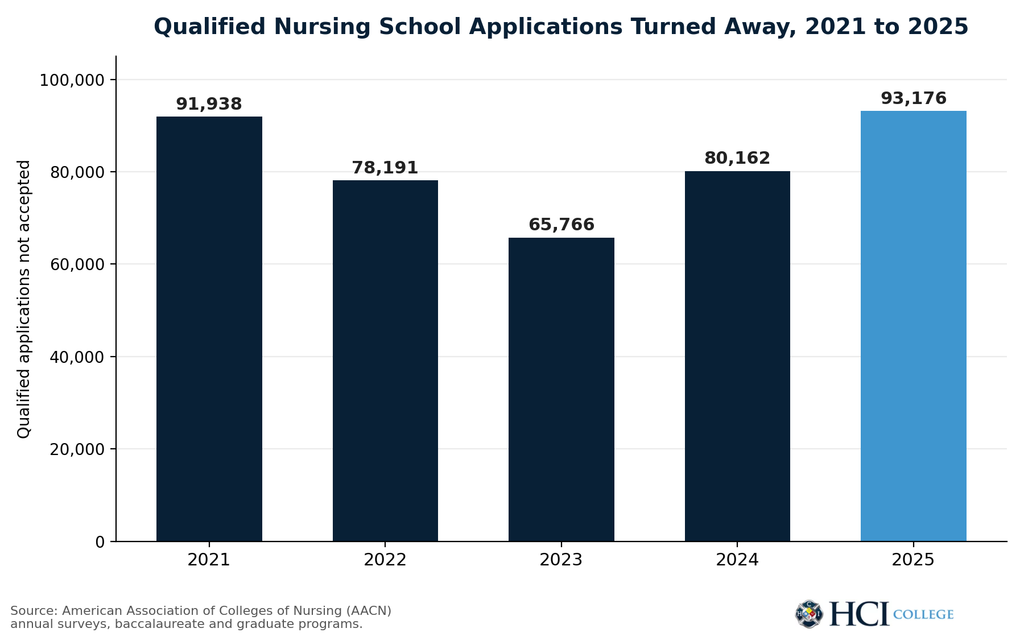
[Alt Text:Bar chart of qualified nursing school applications turned away in the U.S. from 2021 to 2025, reaching 93,176 in 2025, based on AACN data.]
- Dedicated skills and simulation labs: Find out how many lab hours the curriculum includes and whether students complete skills check-offs before moving forward to ensure their clinical experience is comprehensive.
- Experienced instructors: Faculty with recent bedside experience bring real cases into the classroom.
- Accreditation and board approval: Confirm the program is accredited and, for nursing, approved by the state board so you can sit for the NCLEX.
- Variety of clinical sites: Rotations across hospitals, long-term care, and outpatient settings help you discover where you fit best.
A school that meets all five is offering hands-on training in healthcare that will carr straight into your first shift.
Build Real Skills With HCI College
At HCI College, practice starts in the lab and continues at the bedside. Our simulation rooms are designed to look like actual hospital rooms, so students rehearse patient care in a realistic setting before they ever step onto a unit. Every nursing, medical assisting, and veterinary assisting program combines simulation lab training with experience in medical facilities and other field settings.
Students in our Practical Nursing Diploma and Associate Degree in Nursing programs also complete skills check-offs in the Nursing Skills Lab, because clinical sites are for applying skills students have already mastered. Explore how students move from classroom to clinic at our Fort Lauderdale and West Palm Beach campuses, then contact us today to learn how our hands-on training in healthcare can prepare you for day one on the job.
If you found this article helpful, please share it on social media to help others in the healthcare field.