How Veterans Can Transition Into Healthcare Careers
For many veterans, years of hands-on medical training in the military do not automatically translate into a civilian healthcare career. A combat medic or Navy corpsman who spent years treating patients under intense pressure can come home to find that none of it counts toward a license or a job title employers recognize, sometimes landing in work that has nothing to do with healthcare while they figure out the next step.
That gap sits at the center of a much bigger pattern. Every year, more than 200,000 service members leave the military and step into civilian life, many carrying years of hands-on medical training that the healthcare industry badly needs. Yet the path from combat medic to civilian caregiver is rarely as simple as walking across a parking lot.
When it comes to healthcare careers for veterans, understanding how military experience actually translates, where the real gaps are, and what the first step looks like can make all the difference in building a second career with staying power.
Why Healthcare Is a Good Fit for Veterans
According to the U.S. Bureau of Labor Statistics, the veteran unemployment rate held at 3.5% in 2025, lower than the 4.2% rate for nonveterans. Healthcare was a big part of why, adding jobs faster than most other industries throughout the year even as hiring slowed elsewhere.
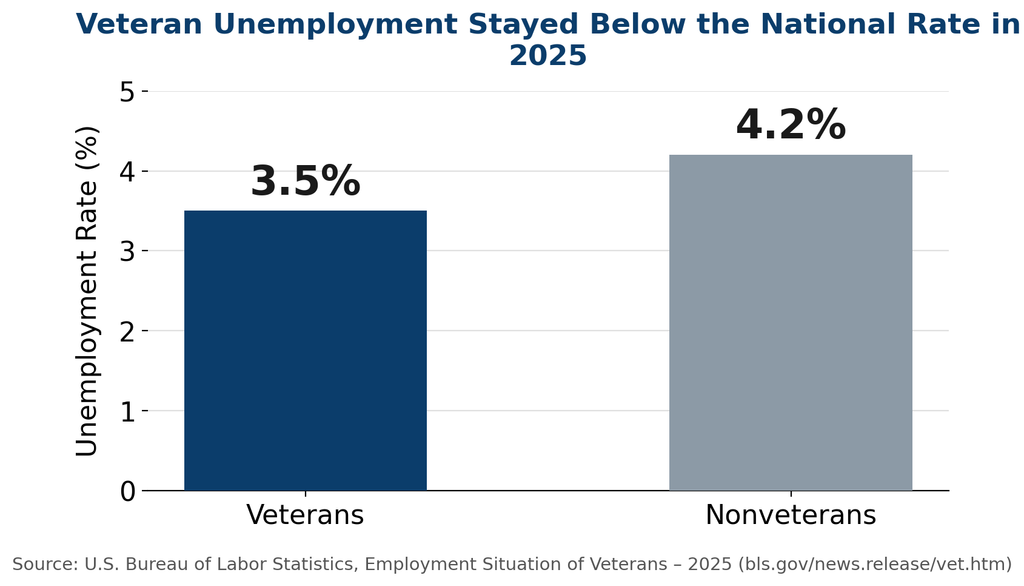
[Alt Text: Bar chart comparing 2025 unemployment rates, veterans at 3.5% and nonveterans at 4.2%, based on U.S. Bureau of Labor Statistics data.]
That demand is not spread evenly, and Florida is one of the places feeling it most. The state is short of tens of thousands of nurses, a gap driven largely by its fast-aging population, and it is only expected to widen over the next decade. For veterans willing to retrain, a shortage like that means faster hiring, more openings, and less competition than in a saturated civilian job market.
That combination, steady demand, faster hiring, and work that still feels worth doing, is what sets healthcare apart from most second careers. Healthcare careers for veterans are thus one of the clearest paths to steady work, strong benefits, and a job that still feels like it matters.
Transferable Skills from Military to Healthcare
Military service builds habits that translate directly to patient care, even when the job titles look nothing alike.
- Working Under Pressure
Combat medics and hospital corpsmen are trained to make fast, accurate decisions when something goes wrong. That same instinct keeps a code cart moving and a chaotic emergency room organized.
- Following Protocol
The military runs on checklists, chain of command, and standard operating procedure. Healthcare runs largely the same way, from sterile technique to medication administration.
- Team-Based Care
No unit succeeds alone, and neither does a nursing floor. Veterans are used to relying on the person next to them and being relied on in return.
- Attention to Detail
Vital signs, dosages, and lab values leave little room for error. Veterans who tracked equipment, supplies, or mission logs already understand what precision under scrutiny feels like.
- A Sense of Purpose
Few career fields reward mission-driven work the way healthcare does. For veterans missing the structure and meaning of military life, patient care can restore some of both.
Career Options for Veterans in Healthcare
Not every path requires years of additional schooling. That range is part of what makes healthcare positions for veterans so accessible, whether someone wants to start working within months or is ready to commit to a multi-year degree. Depending on their background, veterans can move into healthcare through a few different entry points.
- Medical Assistant: This is a strong fit for veterans who handled basic patient care, administrative work, or logistics during service. HCI College’s Medical Assisting Program trains students for both administrative and clinical duties in as little as 10 months.
- Licensed Practical Nurse (LPN): Veterans with direct clinical exposure, especially former corpsmen and combat medics, often move quickly through practical nursing coursework. The Practical Nursing Diploma prepares graduates to sit for the NCLEX-PN licensing exam.
- Registered Nurse (RN): For veterans ready to commit to a longer program, an Associate Degree in Nursing opens the door to higher pay, more autonomy, and leadership roles later on.
There is, however, one catch worth knowing up front. In most states, military medical training does not automatically transfer into a civilian license, no matter how much hands-on experience it involves. Choosing an accredited program built to bridge that gap, rather than assuming military service alone is enough, is often what separates a fast transition from a frustrating one.
Healthcare Organizations That Hire Veterans
One of the fastest ways for a veteran to break into healthcare is to search for an employer that already has infrastructure built for military hires. These organizations often provide credentialing support, mentorship, and hiring pipelines designed specifically for veterans and military spouses. It’s proof that healthcare careers for veterans are backed by real hiring commitments.
• HCA Healthcare – HCA Healthcare has hired more than 65,000 military veterans and military spouses since 2012 through its Military Affairs program, and operates hospitals across South Florida.
• AdventHealth – AdventHealth operates more than 50 hospitals across nine states, including several Florida campuses, and runs a dedicated careers site built specifically for transitioning veterans.
• Cardinal Health – Cardinal Health offers a free Veterans Professional Advancement Course that helps service members leaving the military, along with military spouses translate their experience into civilian resumes and interviews.
• Premise Health – At Premise Health, roughly 1 in 15 team members comes from the military community, supported through a dedicated Military Affairs Program.
• Main Line Health – Main Line Health actively recruits veteran talent for nursing and clinical roles, in the belief that that military leadership translates directly into nursing leadership.
• CVS Health – Through its Heroes2Careers program and a Talent Connect Center at Fort Bragg, CVS Health helps veterans and military spouses move into pharmacy, retail health, and clinical roles.
Start Your Healthcare Career With HCI College
Healthcare careers for veterans do not have to start from zero. The discipline, teamwork, and composure built during service map directly onto what healthcare employers and healthcare schools look for every day. At HCI College, our Medical Assisting, Practical Nursing, and Associate Degree in Nursing programs are built for exactly the kind of hands-on, high-stakes work many veterans already know well.
Contact HCI College today to find out which program fits your background best.
If you found this article helpful, please share it on social media.