How Continuing Education Boosts Healthcare Careers
Think about how much has changed in medicine over the past decade alone. New treatment protocols, updated diagnostic tools, expanded telehealth infrastructure, revised clinical guidelines, and more. And yet, the gap between emerging scientific knowledge and its real-world application at the bedside grows wider every year. For healthcare professionals, continuing education is about staying relevant, licensed, and competitive.
What you learned a few years ago may no longer reflect current best practices. That’s where continuing healthcare education comes in. More than a requirement, it’s a practical way to sharpen skills, build confidence, and open new career opportunities. For many healthcare professionals, it’s also the difference between staying in the same role and moving forward.
What is Continuing Education in Healthcare?
Continuing education refers to any structured learning that healthcare professionals pursue after completing their initial degree or training. It can look like a weekend certification course, an online module for license renewal, a hands-on workshop, or a full advanced degree program.
Continuing healthcare education serves two core functions:
- Maintaining current practice
- Translating new knowledge into everyday care
Why Employers Value Ongoing Training
From a hiring manager’s perspective, a candidate who invests in their own development is a safer bet. Employers value professionals who are committed to staying current with industry trends and innovations. This signals accountability and a long-term mindset — qualities that matter in a high-stakes environment like healthcare.
A commitment to continuing education helps organizations attract and retain skilled talent. This investment shows employees that their growth matters, which improves morale and job satisfaction. That dynamic works both ways: professionals who pursue CE tend to feel more engaged, and organizations that support it tend to hold onto their best people longer.
There’s also the practical side of compliance. Most employers and licensing boards require ongoing education in order to be eligible to work and maintain a valid license.
Common CE Paths
The right CE path depends on where you are in your career and where you want to go. Some of the most common routes include:
- AHA Certifications and Renewals: The American Heart Association offers courses in Basic Life Support (BLS), Advanced Cardiovascular Life Support (ACLS), and Pediatric Advanced Life Support (PALS). These certifications are required across nearly every clinical setting and must be renewed regularly.
- Advanced Nursing Education: Nurses have a particularly wide range of CE options, from specialty certifications in areas like critical care or gerontology to full LPN-to-RN bridge programs. Continuing education for nurses typically addresses medications, treatments, coaching healthy habits, medical ethics, on-the-job communication, and legal issues, keeping professionals up to date and helping them avoid liability.
- Counseling and Mental Health Credits: Licensed counselors, social workers, and mental health professionals are often required to earn CE credits each licensure cycle. These can focus on emerging therapies, ethics, trauma-informed care, or specific client populations.
The Real Benefits: Advancement, Pay, and Specialization
The most immediate reason people pursue continuing healthcare education is often licensure renewal. But the downstream benefits go much further; here are five of them.
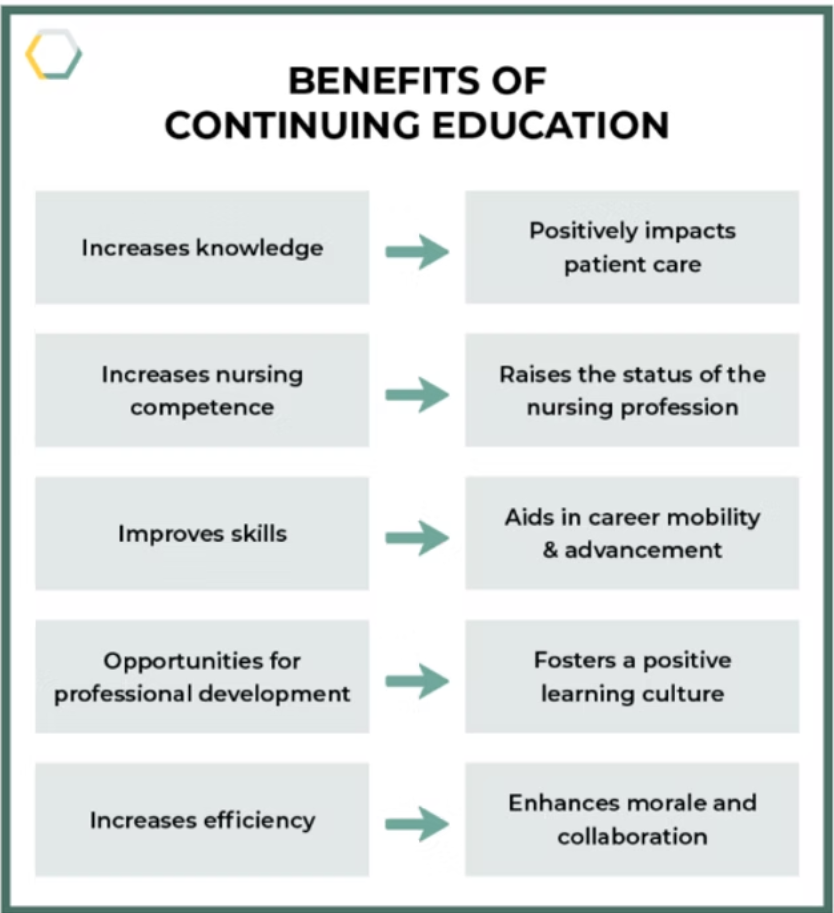
[Alt text: Five benefits of continuing education in healthcare: It increases knowledge, improves nursing competence, builds skills, supports professional development, and increases efficiency.]
- Career Advancement
Nurses who pursue advanced degrees can move into leadership or specialized clinical roles. Medical technologists with updated certifications qualify for more complex, senior-level positions. Across every healthcare discipline, education is one of the clearest paths to moving up.
- Higher Earning Potential
Advanced credentials don’t just look good on a resume, they often come with a direct pay bump. In fact, according to the Robert Half 2026 Salary Guide, 79% of nonclinical healthcare leaders say they typically offer higher salaries to candidates with specialized skills than to those without them in the same role.
- Specialization
Healthcare is broad, and CE lets you carve out your own lane within it. Whether you’re drawn to emergency response, pediatric care, mental health, or clinical leadership, targeted coursework helps you build deep expertise in the areas that genuinely interest you, and it makes you a stronger candidate for roles in those niches.
- Greater Professional Confidence
Staying current in your field means showing up to work knowing you’re prepared. Professionals who invest in their ongoing learning tend to feel more at ease handling complex clinical situations, which naturally leads to better patient interactions and stronger day-to-day decision-making.
- Job Security and Employer Trust
In a competitive hiring market, employers notice when a candidate takes their development seriously. Professionals who actively invest in their growth are often first in line when new opportunities arise, making them harder to replace.
How to Plan Your Continuing Education Journey
Starting a continuing healthcare education doesn’t have to feel overwhelming. A few practical steps can help you build momentum.
- Align with career goals: Choose courses and certifications that move you toward that goal, whether it’s leadership, specialization, or a role change.
- Understand requirements: Be clear on what’s mandatory for license renewal versus what’s optional for growth. This helps prioritize time and effort.
- Choose flexible learning formats: Online modules, hybrid programs, and microlearning options make it easier to fit continuing healthcare learning into busy schedules.
- Track progress consistently: Maintain a record of completed courses, credits, and certifications. This simplifies renewals and strengthens your professional portfolio.
- Look beyond compliance: Don’t stop at the minimum required credits. The real value of continuing healthcare education comes from learning that expands your capabilities, not just meets requirements.
Take the Next Step With HCI
Whether you’re just entering the healthcare field or looking to advance the career you’ve already started, continuous learning is one of the most direct investments you can make. At HCI College, we offer American Heart Association certification courses, including BLS, ACLS, and PALS for both healthcare professionals and community members. Our nursing and medical assisting programs are also built with long-term career growth in mind, giving students a strong foundation from day one.
Ready to take your next step? Contact HCI College to learn more about our programs and AHA course offerings.
If you found this article helpful, please share it on social media.