5 Reasons Why Now Is the Best Time to Start a Healthcare Career
Even when the world changes through economic shifts, new technologies, or even global health challenges, there is one field that remains at the center: healthcare. No matter what else evolves, society cannot function without healthcare workers.
Nurses, medical assistants, paramedics, and technicians form the backbone of our communities. They are the people we turn to during emergencies, transitions, and some of life’s most vulnerable moments.
Right now, the healthcare industry is at a tipping point. Aging populations, workforce shortages, and rapid technological advances are colliding to create both a challenge and an opportunity. This is not just a good time to start a healthcare career — it’s the best time. These five factors make healthcare a top career choice now and in the coming years.
1. The Growing Demand for Healthcare Workers
The demand for healthcare professionals is expanding faster than almost any other field. It’s not just the traditional roles anymore; advances in telemedicine, digital health, and electronic health records have created opportunities that didn’t even exist two decades ago. From virtual care specialists to developers designing tools that support patient care, new paths are opening every year.
Another influence that makes this moment unique is the urgency. Hospitals, clinics, and outpatient facilities are actively competing for qualified professionals. For anyone considering a healthcare career, that translates into:
- Higher chances of employment
- More options for location
- The ability to grow into areas of specialization
In most industries, you train first and then hope the market has a place for you. In healthcare, the market is already asking: When can you start?
2. Short-Term Training Programs Available Now
A misconception about healthcare is that you need years of schooling before you can make a difference. The reality is that many career paths, like medical assisting, practical nursing, and veterinary assisting, can be launched in under two years, sometimes less.
Across the industry, employers are embracing “earn while you learn” pathways and pipeline partnerships with colleges. This shortens the distance between your first day in class and your first paycheck.
These programs are also evolving to include recent advances in technology. At HCI, medical assisting students get hands-on practice with electronic health records in labs, while practical nursing students train in simulation labs that feel like real hospital settings. That means graduates aren’t just ready for their first job, they’re prepared for a career in healthcare that will keep growing as the industry changes.
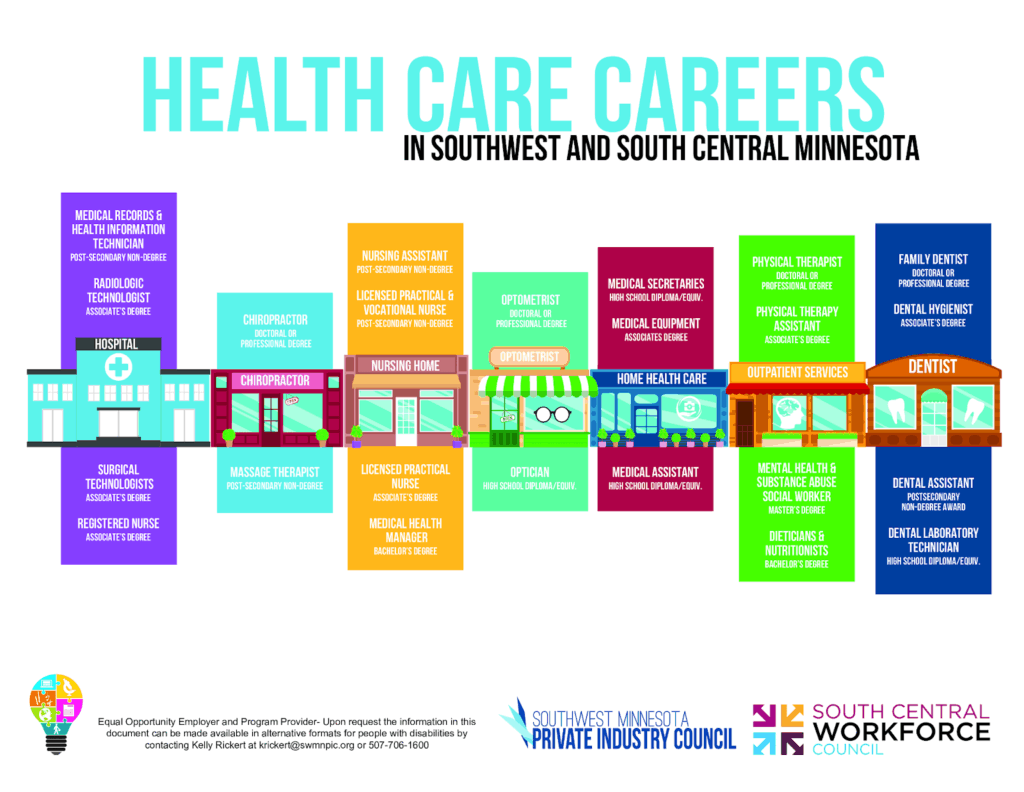
Image Source An example of healthcare careers arranged by level and projected demand.
[Alt txt: Fastest-growing healthcare careers, with education requirements and projected demand (2021–2031)]
3. Growth Opportunities in Healthcare Careers
In 2023, the U.S. healthcare sector accounted for 17.6% of the GDP, nearly one‑fifth of the entire economy. An industry of this size naturally generates abundant opportunities for healthcare workers at every level.
Healthcare work doesn’t have to be static. You can start in one role and build your way upward, sideways, or even into entirely new specialties. Someone may start as a medical assistant, move into nursing, and later pursue specialized or leadership positions. Thus, choosing a career-based college program can help position you for long-term growth in many environments.
Other clear benefits include:
- Competitive pay: High demand often drives better wages and incentives.
- Flexible work settings: Hospitals, clinics, private practices, and travel roles provide options to match your lifestyle.
- Transferable skills: Clinical and communication abilities open doors for advancement. Learning how to excel in patient relations, for example, can turn everyday interactions into moments of trust and care.
4. Job Stability and Purpose in Healthcare Careers
In uncertain times, job stability is one of the primary concerns. Healthcare careers have consistently proven recession-resistant. Even during economic downturns, demand for care holds steady and often increases.
According to the Bureau of Labor Statistics registered nursing alone is expected to see 189,100 average annual job openings between 2024 and 2034. Medical assisting, practical nursing, and allied health roles follow the same upward trend. These numbers reflect the reality that healthcare jobs don’t disappear when economies shift.
And then there’s purpose. Many in healthcare will tell you it’s not just a paycheck that keeps them going. It’s knowing their work eases pain, brings reassurance, and helps patients reclaim their health. Very few professions let you see your impact so directly, day after day.
5. A Field That Puts People First, Even in a Tech-Driven Era
AI is already changing how care is delivered, but always as a support to clinicians rather than as a replacement.
For example, the NHS recently rolled out an AI tool that analyzes stroke CT scans in under a minute, cutting treatment delays nearly in half and improving recovery rates. In the U.S., health systems like those at Cedars-Sinai are testing AI documentation and diagnostic tools that reduce charting time.
These innovations save time and make care more efficient, but what truly matters can’t be automated. Healthcare workers bring judgment, empathy, and human connection that no machine can replace. Technology may handle data, but it can’t offer comfort, reassurance, or the simple act of listening when a patient needs it most. At its heart, the healthcare field will always be about people caring for people.
Launch Your Healthcare Career With HCI
The healthcare industry is one of the few where change creates more opportunity, not less. The rising demand for skilled professionals, the availability of short-term training programs, the promise of career growth, and the resilience of the field all point to one truth: there has never been a better time to start a job in healthcare.
At HCI College, we make that path possible. Our programs, anchored in hands-on training, simulation labs, and clinical experience, ensure that your pathway toward a healthcare career is built on real-world readiness. We offer ongoing career placement support, and our faculty and schedule structure accommodate real lives and changing job markets.
If you’re ready to take the next step, HCI College programs can help you turn your goals into a rewarding healthcare career.
If you found this article interesting, please share it with your friends.