The Quickest Healthcare Certifications You Can Earn in Under 12 Months
Breaking into healthcare doesn’t have to mean years of school and mountains of student debt. Today, some of the most in-demand roles in the industry can be reached in under 12 months, or sometimes in just a few weeks. And the credentials are worth it: according to NHA’s Industry Outlook, 96% of employers require or encourage certification for roles like medical assistants and phlebotomy technicians.
Whether you are a recent high school graduate, a career-changer, or someone re-entering the workforce, short-term healthcare certifications offer a practical, cost-effective gateway to a rewarding and in-demand healthcare career.
Why Short-Term Medical Certifications Are Popular Today
Short-term healthcare certifications have surged in popularity because they offer speed to employment (as little as four weeks), lower cost compared to a degree, strong employer demand for credentialed candidates, and flexible online or hybrid formats that fit around existing schedules. Many also serve as stepping stones to higher-level roles in nursing, pharmacy, or veterinary technology. This demand is also driven by strong job growth across healthcare roles that don’t require a four-year degree.
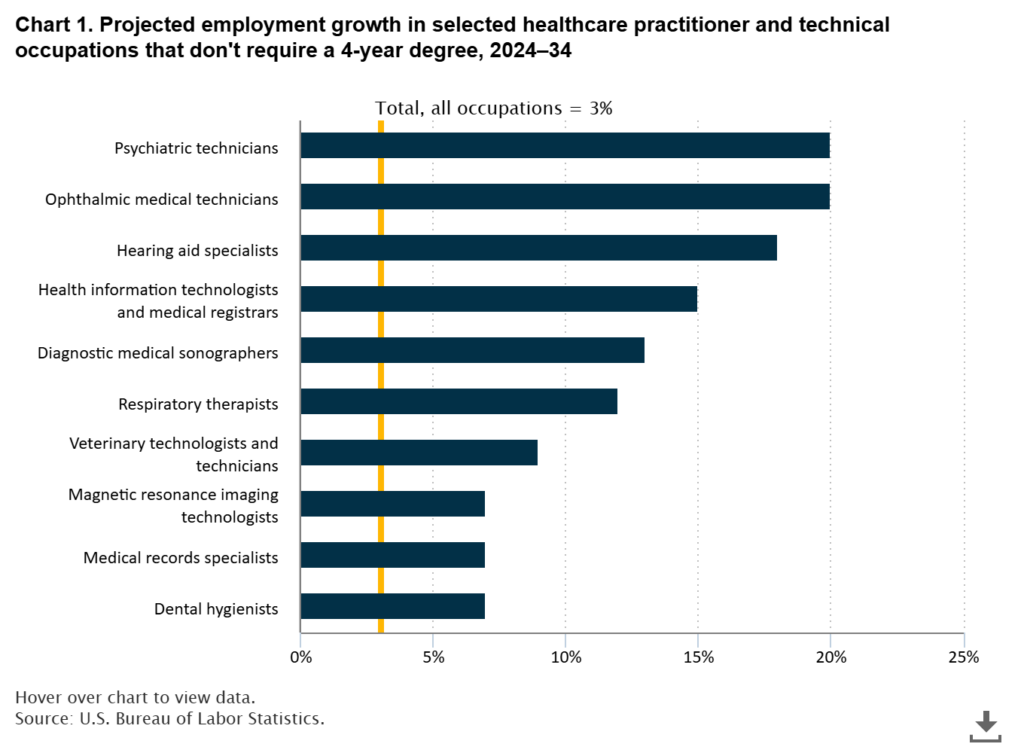
[Alt Text: Projected employment growth for healthcare jobs without a 4-year degree (2024–2034), showing faster-than-average growth.]
In addition to speed and demand, these programs offer flexible learning formats, including online and hybrid options, making them accessible to working professionals and career switchers.
Top 7 Entry-Level Certifications Under 12 Months
Below is a detailed breakdown of the most popular and in-demand healthcare certifications that can realistically be earned in under a year.
1. Certified Nursing Assistant (CNA)
Certified Nursing Assistants provide direct, hands-on patient care under the supervision of registered nurses and licensed practical nurses.
Duration: CNA programs are among the fastest in all of healthcare, typically lasting 4 to 12 weeks, depending on state requirements and whether the program is full-time or part-time.
Certification Process: After completing a state-approved program, candidates must pass a two-part competency exam: a written (or oral) knowledge test and a hands-on skills evaluation. Requirements vary by state, so always check with your specific state’s nursing board.
2. American Heart Association (AHA) – Basic Life Support (BLS) Certification
The AHA’s BLS certification is a foundational credential required by virtually every employer across the healthcare industry. It trains students to identify life-threatening emergencies, perform high-quality CPR for adults, children, and infants, use an AED correctly, deliver appropriate ventilations, and respond to opioid-associated emergencies.
Duration: BLS can be completed in a single day. The blended learning format (HeartCode BLS online + a hands-on skills session) is especially popular, allowing you to complete the cognitive portion at your own pace before attending an in-person skills check. The BLS Provider eCard is valid for two years.
Certification Process: Candidates must complete the course (either instructor-led or blended format) and pass a hands-on skills assessment conducted by an AHA-certified instructor.
3. Certified Medical Assistant (CMA / CCMA)
Medical assistants are versatile allied health professionals who handle both clinical and administrative duties. Clinical tasks include taking patient histories, measuring vital signs, preparing patients for examination, drawing blood, administering medications, and assisting with minor procedures.
Administrative tasks include scheduling appointments, maintaining medical records, managing billing, and handling patient correspondence. According to the BLS, the job growth rate for medical assistants is projected at 12% from 2024 to 2034, one of the fastest of any healthcare role.
Duration: Most medical assisting programs required to sit for the CMA (AAMA) or CCMA (NHA) exam can be completed in 9 to 12 months. Some online programs (such as Stepful’s CCMA-focused program) can be finished in as little as 5 months.
Two Major Certifying Organizations:
- Option A: CMA (AAMA) – American Association of Medical Assistants
Eligibility: Candidates must graduate from a medical assisting program accredited by either the Commission on Accreditation of Allied Health Education Programs (CAAHEP) or the Accrediting Bureau of Health Education Schools (ABHES).
- Option B: CCMA (NHA) – National Healthcareer Association
Eligibility: High school diploma or GED plus completion of an accredited MA program within the last 5 years OR 1 year of supervised work experience within the last 3 years.
4. Phlebotomy Technician (CPT / PBT)
Phlebotomists are specialists in drawing blood for diagnostic testing, transfusions, research, and donations. They work in hospitals, diagnostic laboratories, blood donation centers, outpatient clinics, and mobile blood collection units.
Duration: Most phlebotomy training programs can be completed in 4 to 8 weeks, though some may extend up to 3 months depending on clinical requirements.
Certification / Eligibility:
- Option A: CPT – NHA (National Healthcareer Association)
High school diploma or GED + completion of a phlebotomy training program within the last 5 years + required clinical experience.
- Option B: PBT – ASCP (American Society for Clinical Pathology)
High school diploma + completion of a NAACLS-accredited program or an approved alternative route.
5. Certified Pharmacy Technician (CPhT)
Pharmacy technicians work under the supervision of licensed pharmacists to fill prescriptions, prepare compound medications, manage inventory, verify insurance, and assist with patient interactions.
Duration: Most pharmacy technician programs can be completed in 4 to 12 months, depending on the format and level of training.
Certification / Eligibility:
- Option A: CPhT – PTCB (Pharmacy Technician Certification Board)
Requires a high school diploma and passing the PTCE exam.
- Option B: ExCPT – NHA (National Healthcareer Association)
Requires a high school diploma and either completion of a training program or relevant work experience.
6. EKG / Cardiac Monitor Technician (CET)
EKG (electrocardiogram) technicians, also called cardiac monitor technicians, operate electrocardiograph machines to detect abnormal heart rhythms, heart disease, and other cardiac conditions. They work primarily in hospitals, cardiology clinics, and diagnostic centers.
Duration: Programs typically run 6 to 10 weeks, making this one of the fastest certifications in healthcare.
Certification / Eligibility:
The National Healthcareer Association (NHA) offers the Certified EKG Technician (CET) credential. Candidates typically need a high school diploma and completion of a training program or relevant work experience.
7. Approved Veterinary Assistant (AVA)
The Approved Veterinary Assistant (AVA) credential is offered by the National Association of Veterinary Technicians in America (NAVTA). Veterinary assistants support veterinarians and credentialed veterinary technicians in both clinical and administrative tasks, including animal handling, assisting with procedures, administering medications, maintaining records, and client communication.
Duration: NAVTA-approved programs range from 3 to 12 months and include a required hands-on externship.
Certification / Eligibility:
Candidates must graduate from a NAVTA-approved veterinary assistant training program, which includes both coursework and practical training at a veterinary facility.
How to Choose the Right Program for Your Healthcare Career
Short-term healthcare certifications make it possible to enter the workforce faster, with lower costs and job-ready skills that employers value. Whether you’re starting fresh or upskilling, the right program can open doors quickly while setting the stage for long-term growth.
At HCI, we focus on career-aligned training, hands-on learning, and industry-recognized certifications designed to help learners move from education to employment with confidence.
Explore HCI’s certification programs and take the next step toward a healthcare career that starts sooner and goes further.
If you found this article helpful, feel free to share it with someone who might be considering a future in healthcare.