Top Factors Driving Burnout Among Healthcare Workers (and How to Address Them)
There is a common saying, “You can’t pour from an empty cup.” Many people find it to be true, and especially so in healthcare, where the idea carries serious consequences. Professionals are expected to deliver precision, empathy, and calm under pressure, often for long hours and with limited support. Over time, these demands can accumulate and contribute to rising levels of burnout across the workforce.
The implications extend beyond individual well-being. Burnout can affect team stability, patient care, and the long-term sustainability of healthcare systems. As organizations work to address this growing challenge, several important questions emerge:
- What happens to patient safety when moderate burnout becomes the “normal” baseline for healthcare teams?
- If nearly half of healthcare professionals report burnout symptoms, is this an individual resilience issue or a system design failure?
- How sustainable is a healthcare workforce where experienced professionals are leaving faster than new graduates can replace them?
Understanding the key drivers behind healthcare worker burnout and how to address them is critical for building sustainable careers in this field.
What Is Healthcare Worker Burnout?
Healthcare worker burnout is more than feeling tired after a long shift. It is ongoing physical, emotional, and mental exhaustion caused by prolonged stress at work.
According to the American Nurses Association, burnout often includes three core signs:
- Emotional exhaustion
- Feeling detached or numb toward patients
- Reduced sense of accomplishment
In simple terms, it feels like running on empty for weeks or months. This definition is not theoretical. Research shows how measurably widespread burnout has become.
How Burnout Progresses in Healthcare Roles
Burnout often develops gradually and can be hard to recognize. Healthcare professionals frequently begin their careers with strong motivation and a sense of purpose, but sustained workload pressure, emotional strain, and limited recovery time can slowly erode engagement.
A typical burnout trajectory moves from high expectations to disappointment and frustration, leading to dissatisfaction, and eventually disengagement and, eventually, severe exhaustion and health decline if workplace factors remain unaddressed.
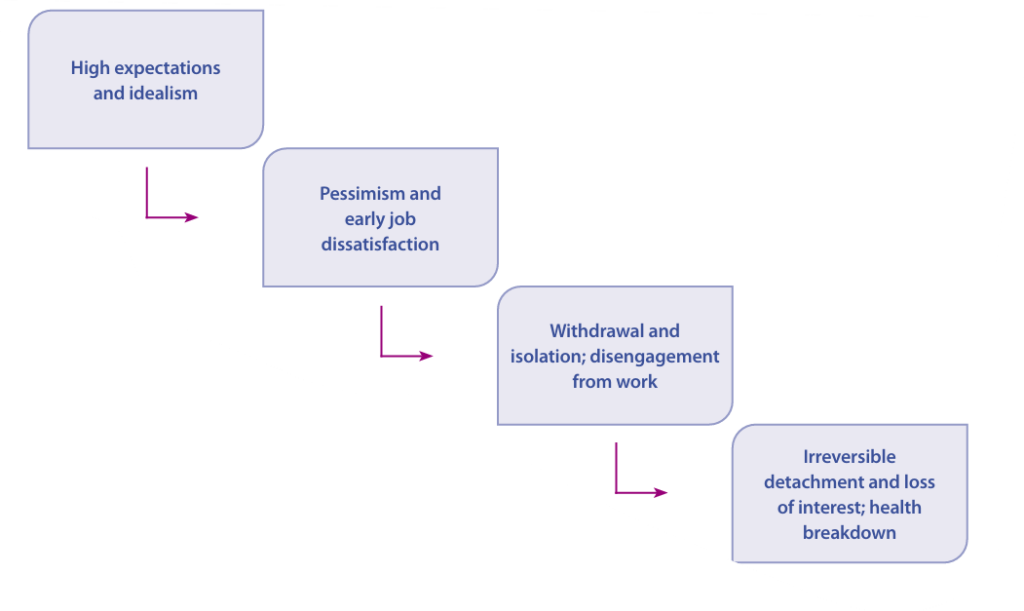
[Alt Txt: Burnout in healthcare professionals often develops on a trajectory from high expectations and idealism to early job dissatisfaction, withdrawal, disengagement, and eventually severe detachment and health decline if prolonged stress is not addressed.]
3 Causes of Worker Burnout
Why does this happen? Several factors drive healthcare worker burnout, but three stand out consistently across the industry.
1. Staffing Shortages
One of the biggest causes of nurse burnout is chronic understaffing. When there aren’t enough team members on a shift, the workload doesn’t shrink; it simply shifts to those who are present. A nurse may care for more patients than is safe or manageable. Breaks are skipped, and documentation piles up.
Over time, constant overload leads to exhaustion and frustration. Workers feel they cannot provide the quality of care they were trained to deliver. That gap creates stress and sometimes, even guilt.
2. Long Shifts and Heavy Workloads
Healthcare often requires 12-hour shifts, overnight schedules, or back-to-back workdays. While some professionals prefer longer shifts, the physical and mental toll adds up.
Fatigue affects focus, decision-making slows down, and recovery time becomes shorter. Add charting, administrative tasks, and electronic records on top of patient care, and the workday rarely ends when the shift does.
3. Emotional Strain
Healthcare is emotionally intense. For many new professionals, these emotional demands are among the biggest challenges of becoming a nurse, especially during the transition from classroom learning to real clinical environments.
Professionals support patients through pain, loss, and uncertainty every day. Over time, repeated exposure to trauma, suffering, and high-stakes decisions can lead to compassion fatigue. Without support, this emotional weight contributes heavily to burnout.
Consequences for Patients and Workers
Healthcare worker burnout affects both patient care and workforce stability. The impact is not isolated. It spreads across the system.
| Impact Area | What It Looks Like | Why It Matters |
| Patient Care | Increased medical errors | Fatigue reduces focus and decision-making accuracy |
| Lower patient satisfaction | Rushed communication affects trust and experience | |
| Reduced quality of care | Emotional exhaustion limits attentiveness | |
| Healthcare Workers | Anxiety, depression, sleep issues | Ongoing stress affects mental health |
| Job dissatisfaction | Professionals feel disconnected from their purpose | |
| Higher turnover rates | Staff attrition worsens shortages and the workload |
These consequences are interconnected. When healthcare workers struggle, patient care inevitably feels the strain. Addressing healthcare worker burnout is about protecting the quality and safety of care.
4 Strategies to Prevent and Manage Burnout
Addressing healthcare worker burnout requires both system-level changes and individual support. Telling professionals to “practice self-care” is not enough. The work environment must change, too.
1. Improve Staffing and Workload Distribution
Reducing patient-to-staff ratios helps prevent overload. Even small adjustments in scheduling can lower stress. Offering shift options such as 6, 8, or 12-hour schedules, along with flexible time-off policies, can better support work-life balance and reduce fatigue.
Hospitals that invest in adequate staffing often see better patient outcomes and lower turnover. When professionals feel supported, performance improves.
2. Provide Mental Health and Peer Support
After a traumatic experience, access to counseling services, peer groups, and debrief sessions makes a difference. For example, structured team debriefs after critical incidents allow staff to process emotions instead of carrying them silently. Support should be normalized, not seen as a sign of weakness.
3. Strengthen Leadership and Communication
Leaders who check in regularly, encourage feedback, and respond to concerns create psychological safety. With today’s technology, leaders can use digital check-ins, anonymous feedback tools, and team communication platforms to stay connected with staff in real time.
Attentive leaders identify stress early, respond quickly to concerns, and create a more supportive work environment.
4. Encourage Skill Development and Resilience Training
Training in stress management, time management, and emotional regulation can help professionals cope with high-pressure environments.
- Simulation-based training can expose students to high-stress clinical scenarios in a controlled setting, allowing them to practice decision-making without real-world risk.
- Workshops on boundary-setting and workload prioritization can also help professionals manage competing demands more effectively.
Resilience training works best when paired with structural support. It should not replace systemic solutions.
How Schools Like HCI Prepare Students for the Realities of the Field
In today’s healthcare systems, burnout is a real concern, but preparation can reduce its impact. When future professionals understand the causes of healthcare worker burnout and how to manage stress, they are better equipped to build long, sustainable careers.
Schools like HCI not only help students build clinical skills, but also resilience, teamwork, and realistic expectations about the field. Early exposure to real-world environments and supportive mentorship prepares graduates for high-pressure settings.
Thinking about a future in healthcare? HCI programs are designed to prepare students for the real demands of today’s clinical environments, including the pressures that can lead to burnout. Contact us to learn more about building a strong, sustainable career in healthcare.
If this blog gave you insight into healthcare worker burnout, share it on social media to help spread awareness and support a healthier workforce.