What Employers Are Looking for in Entry-Level Healthcare Professionals
Employers hiring entry-level healthcare professionals want more than just technical ability. They’re looking for entry-level healthcare workers who can bring empathy, communication, and professionalism into every role.
Employers want to see new graduates who can deliver effective care while also contributing to a supportive, patient-centered environment. Understanding these expectations can help you stand out in interviews and begin building a strong foundation for your career.
Top Skills Employers Look for in Medical Assistants and Practical Nurses
When it comes to entry-level healthcare jobs, employers consistently highlight four key areas that determine whether new graduates in medical assisting or practical nursing are ready to succeed.
- Clinical Reliability
At its core, healthcare requires accuracy and consistency. Employers need medical assistants who can record patient vitals correctly, prepare exam rooms, and maintain accurate records. Nurses are trusted with responsibilities like administering medication and monitoring patient conditions. A single mistake can negatively affect patient safety, so reliability is highly valued.
These essential skills are developed through structured training in a medical assisting program or practical nursing program, where students gain both technical competence and soft skills employers value.
For example, during a clinical rotation, nursing students will learn to double-check patients’ medication dosage with the supervising nurse, learning to pay attention to detail and preventing a potential error.
- Communication Skills
Clear communication keeps patients safe and helps teams run smoothly. Medical assistants often serve as the first point of contact, explaining procedures and updating charts. Practical nurses frequently act as the bridge between patients, families, and doctors. Employers look for candidates who can convey information simply and with empathy.
For example, a medical assisting student explains pre-test instructions in plain language to an older patient, ensuring the patient followed the prep correctly so the test can be performed without delays.
- Adaptability
Healthcare settings change rapidly. Patient needs can shift quickly, emergencies arise unexpectedly, and priorities can change in an instant. Employers value professionals who can stay calm under pressure and adjust quickly. Whether it’s covering for a colleague or learning a new electronic health record system, adaptability signals that you’re dependable in unpredictable situations.
For example, when one clinic experienced an unexpected surge of walk-in patients, a medical assisting student volunteered to manage intake paperwork, helping the team keep wait times under control.
- Professionalism and Empathy
Technical skills can be taught, but professionalism and empathy come from mindset. Employers look for individuals who are punctual, respectful, and compassionate, since these qualities directly shape patient experiences. A healthcare professional who listens and shows understanding builds trust with patients and colleagues alike.
For example, a practical nursing student may take a few extra minutes to comfort a nervous child before administering a vaccine, turning a stressful moment into a positive interaction for both the patient and parent.
The demand reflects these expectations. The Bureau of Labor Statistics projects employment of medical assistants will grow 12% from 2024 to 2034, significantly faster than the average across all occupations.
How to Showcase Your Soft Skills in Interviews
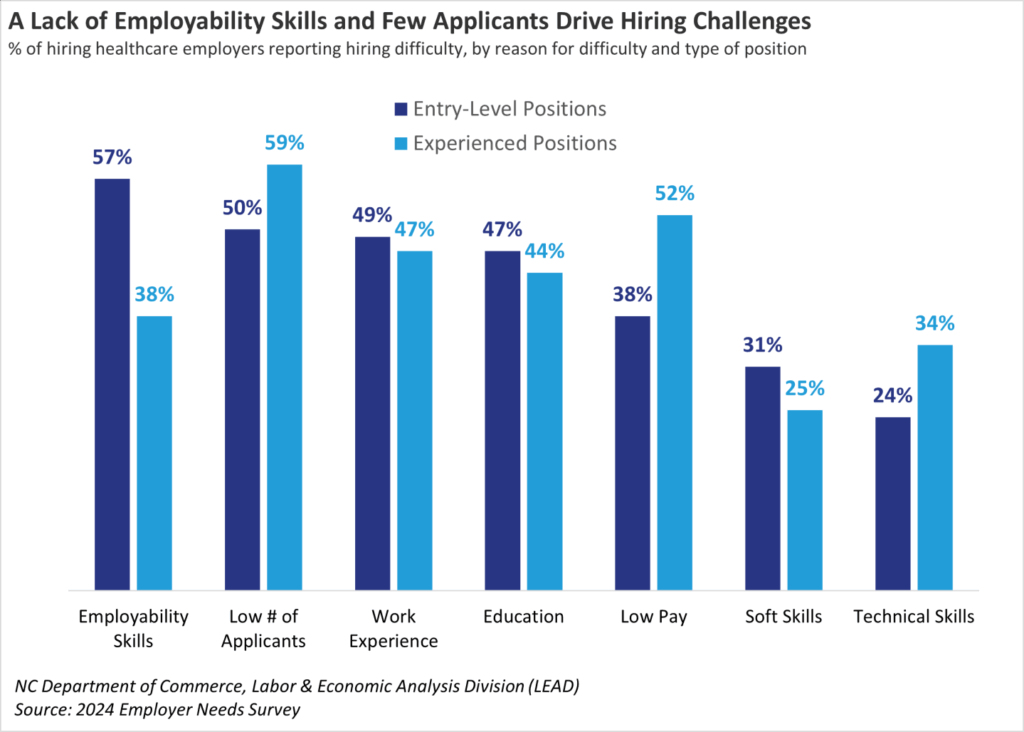
Why do soft skills matter? Employers repeatedly say they are just as important as clinical training. In fact, according to the 2024 Employer Needs Survey, 31% of healthcare employers reported difficulty hiring for entry-level positions due to a lack of soft skills.
The chart below highlights how employers rank employability challenges, showing that communication, adaptability, and professionalism are just as critical as technical knowledge.
[Alt txt: Bar chart showing hiring challenges in healthcare.]
So, how can you make sure interviewers see these qualities in you?
- Use Concrete Examples
Sharing real experiences helps interviewers see how you perform under pressure. For instance, when appropriate, you might describe a moment during clinical training when a patient was nervous about a procedure and you took the time to explain each step calmly, receiving praise from the supervising nurse, who recognized your ability to balance professionalism with compassion.
- Mirror Role-Based Scenarios
Interviewers often ask situational questions to test how you would respond in the workplace. Frame your answers with scenarios from your training that mirror real job responsibilities. Frameworks like the STAR method (Situation, Task, Action, Result) can help you organize your response so interviewers see not only what you did, but also the outcome.
For example, you could talk about how you adapted when the computer program malfunctioned and you were capable and resourceful under pressure, keeping the waiting patients calm and informed while the situation was resolved.
- Ask Insightful Questions
An interview is a two-way conversation, and thoughtful questions show initiative. Instead of asking only about pay or schedules, you might ask, “What kind of mentorship do new staff members receive here?” or “How does your team manage sudden increases in patient flow?”
These questions highlight your curiosity and signal to employers that you’re serious about long-term growth as a healthcare professional.
Building Your Professional Reputation Early in Your Career
The way you approach your first job plays a big role in shaping your long-term career. In a competitive field like healthcare, building a reputation for professionalism and reliability early can set you apart.
- Be Consistently Reliable
Showing up on time, communicating clearly, and following through on tasks may sound basic, but these behaviors establish trust quickly. A medical assistant who always arrives prepared and keeps accurate patient charts makes life easier for the entire team. Over time, reliability like this becomes part of your reputation as a dependable healthcare professional.
- Stay Current and Credentialed
Credentials can open doors. Many employers prefer, and in some cases require, certifications such as Certified Medical Assistant (CMA) from American Association of Medical Assistants or National Certified Medical Assistant (NCMA) from National Center for Competency Testing. Practical nurses must maintain their licensure as well. By keeping your training up to date and seeking opportunities for continuing education, you signal to employers that you’re invested in long-term growth.
- Document Your Strengths
Early in your career, it’s easy to overlook the positive feedback you receive or the progress you make. Keeping a simple record of your clinical experiences, supervisor notes, or patient outcomes can give you concrete examples to reference in future interviews or performance reviews. For instance, writing down how you helped a team reduce patient wait times during your rotation gives you a ready example to share when asked about a problem.
Build a Foundation for Your Healthcare Career With HCI
Starting your career as a healthcare professional is about more than landing a first job. It’s about having the right preparation to grow with confidence in a field that impacts lives every day. Employers want new graduates who are ready to step in with both technical ability and the professionalism to succeed.
At HCI College, our Medical Assisting and Practical Nursing programs are designed to give you that advantage. Through a blend of classroom instruction and hands-on clinical training, you’ll graduate with the skills, confidence, and compassion that employers value in today’s healthcare professionals.
When you’re ready, please check out our programs and take the first step toward your future as a healthcare professional.
If you found this article helpful, please share it on your social media channels.